
What Is a Hand Modeling Portfolio?
In hand modeling, your portfolio has a rather specific job: it must establish your suitability for casting without relying on the usual headshots, runway images, or full-length poses. The attention falls on details such as finger proportions, nail beds, skin texture, wrist flexibility, and how consistently your hands photograph across different angles. These details give casting professionals a clearer basis for assessing your work.
A specialized portfolio typically brings together:
- Clean digitals: Unfiltered close-ups of the backs and palms of your hands, fingers, nails, and wrists.
- Commercial images: Finished shots that demonstrate your ability to present products in a professional setting.
- Measurements: Glove size, ring size, and wrist circumference, where relevant to the casting brief.
- Casting information: Your location, representation status, experience, and professional contact details.
A commercial hand model comp card condenses selected images and essential details into a casting-friendly reference. Your online portfolio gives agencies and clients a fuller view of your capabilities and the range of work you can offer.
Core Differences Between Fashion Modeling and Hand Modeling Portfolios
Criteria | Fashion Modeling Portfolio | Hand Modeling Portfolio |
Primary focus | Overall appearance, proportions, expressions, and movement | Hand anatomy, finger proportions, skin texture, nails, and wrists |
Image selection | Headshots, full-length images, editorials, and campaign shots | Close-ups of palms, backs of hands, fingers, wrists, and product interactions |
Posing technique | Body posture, facial expressions, movement, and garment presentation | Finger articulation, wrist angles, controlled gestures, and precise product handling |
Measurements | Height, chest, waist, hips, and shoe size, as relevant | Glove size, ring size, and wrist circumference, where requested |
Commercial categories | Fashion, runway, beauty, editorial, and lifestyle campaigns | Jewelry, watches, skincare, technology, and other product-focused assignments |
Technical assessment | Styling, garment fit, expression, composition, and overall visual impact | Nail condition, skin detail, finger positioning, reflections, and product visibility |
Portfolio organization | Galleries arranged by campaign, fashion genre, or overall look | Focused galleries arranged by product category and commercial application |
Casting objective | Establish suitability for a particular look, role, or campaign | Establish whether the hands meet the visual and functional requirements of a specific brief |
Essential Elements of a High-Converting Hand Model Portfolio
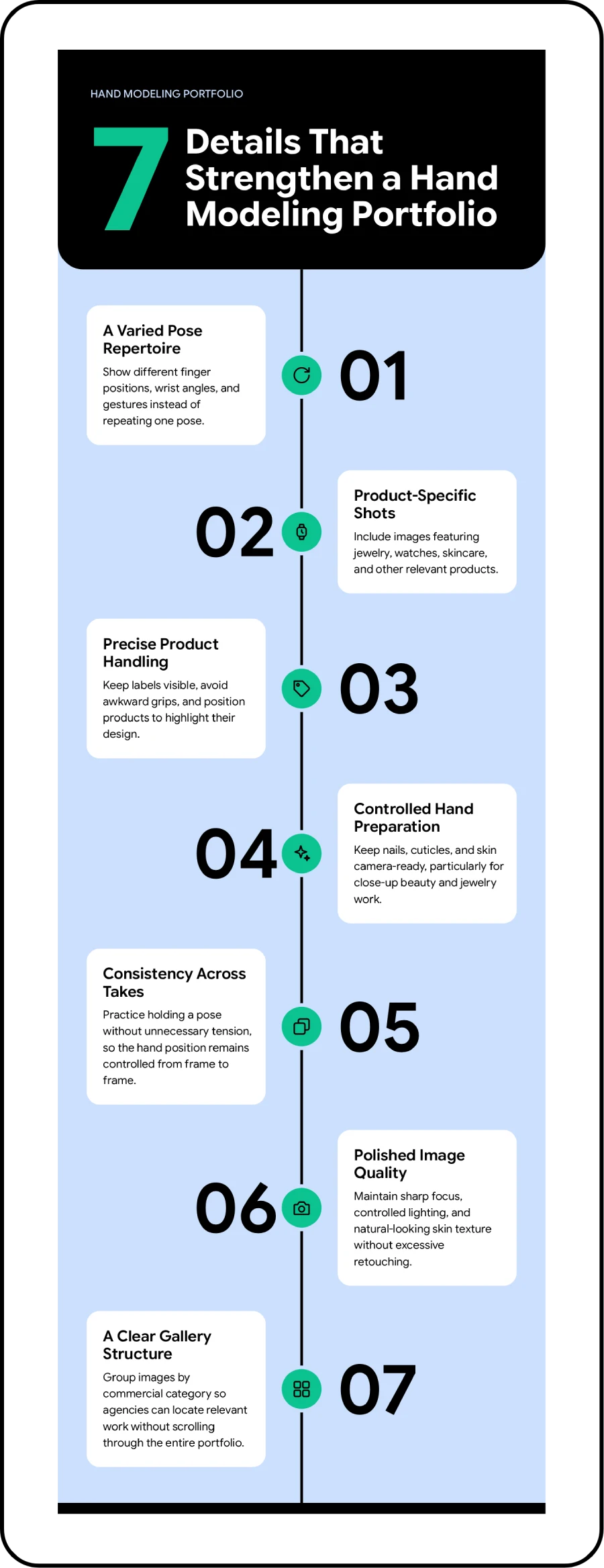
Casting teams have a sharp eye for detail, and a hand modelling portfolio leaves little room for sloppy presentation. From raw digitals to polished campaign work, the selection needs to reflect the standards of commercial casting. Here’s what deserves a place in the final edit.
Step-by-Step: How to Structure Your Hand Modeling Website Layout
Step 1: Choose a Website Builder That Suits Your Work
Start with a platform that gives you enough creative freedom to shape the site around your portfolio, so you can focus on your modelling career rather than website development. Before choosing a platform, check for:
- Template variety: Look for themes with different layouts, typography, and image arrangements, so you can find a design that complements close-up modelling work.
- Customization options: Choose a builder that lets you adjust colors, fonts, galleries, and page layouts without requiring technical expertise.
- Privacy controls: Check whether you can password-protect selected galleries or restrict access to images you aren’t ready to share publicly.
- Analytics integration: Look for support for Google Analytics or comparable tools to understand website traffic, visitor behavior, and which pages attract attention.
- Image presentation: Make sure the platform supports high-quality images without compromising loading speed or display quality.
Your main aim at this stage should be to find a setup that accommodates your work without making every small change a technical exercise.
Step 2: Find the Right Image Layout
Try your photographs in two or three different layouts before choosing one. A Gallery layout gives visitors an overview of your work, while a Slideshow lets you present images in a deliberate sequence. Lightbox allows closer inspection of fine details, Strip accommodates horizontal browsing, and Stacked and Spotlight offer alternative ways to display selected photographs.
Check the crop before you commit: A thumbnail that cuts off the fingertips, obscures a ring, or trims the edge of a product can weaken an otherwise excellent photograph. Keep the original aspect ratio where possible and preview the layout on both desktop and mobile.
Step 3: Curate Galleries Around Commercial Specializations
Give each gallery a clear purpose. Jewelry, watches, skincare, beauty, food, and technology assignments call for different kinds of product interaction, so group images in a way that reflect the work you want agencies to consider you for.
Lead with your strongest category: If watch campaigns are your specialty, place that gallery near the beginning of the site. Within each collection, arrange photographs to show variation in hand positions, angles, and product handling. Similar images can sit together when they form a coherent series but remove near-identical frames that add little to the selection.
Keep gallery names brief and recognizable, such as Jewelry, Beauty, and Technology, as these are easier to scan than clever titles that leave visitors guessing.
Step 4: Develop a Distinct Visual Identity
Your website’s typography, color palette, spacing, and background should complement the photographs rather than compete with them. A muted palette might suit a luxury jewelry portfolio; vivid accents may work better for playful consumer-product campaigns. Let the character of your work guide these choices.
Pay attention to image treatment, too; if possible, avoid AI-generated images. Consistent color correction and careful retouching can lend a portfolio cohesion, while excessive smoothing may erase the skin texture that casting teams need to assess. Use genuine portfolio images to represent your abilities and include video where it demonstrates a skill that a still photograph cannot convey, such as controlled movement or handling a product through a sequence of gestures.
A quick visual check:
- Do the images feel consistent as a collection?
- Are the hands and products the focal point?
- Does the typography remain legible on mobile?
- Does any design element distract from the photographs?
Step 5: Write a Profile That Helps Agencies Assess Your Suitability
Keep the About section concise but make the information specific to your work. Mention your location, experience, commercial specializations, and representation status, along with a professional email address or booking enquiry link.
Include relevant hand measurements when appropriate, such as glove size, ring size, and wrist circumference. State the sizing units clearly and use the format requested by the agencies you approach. If you have experience with product categories or can demonstrate specialist posing skills, make those details easy to find.
Step 6: Run a Final Website Check
Before sharing the link, test the site on both desktop and mobile. Check the navigation, image quality, contact details, gallery permissions, and loading speed. Large image files can slow a page considerably, so compress photographs for the web while preserving the detail needed for close-up viewing.
Use this checklist before publishing:
- Every gallery opens and displays correctly.
- Images retain their intended composition on mobile.
- Contact and enquiry links work.
- Private galleries have the correct access settings.
- Analytics are configured, if you plan to use it.
- The strongest work appears near the beginning.
As your experience develops, revisit the selection and replace older images when new work better represents your abilities. For anyone exploring how to become a hand model, the website can develop alongside their professional experience, giving agencies an up-to-date view of their work and specializations.
Step Into the Spotlight: Elevating Your Hand Modeling Portfolio
In the high-glamour arenas of luxury global campaigns, your hand modeling portfolio is your ultimate digital stage. When multi-million-dollar brands showcase flagship timepieces, high-carat diamonds, or iconic beauty lines, every frame demands flawless precision and cinematic allure. Casting directors do not have time to hunt through clutter. They need an immediate, high-impact glimpse of your skin texture, hand grace, and seamless product interaction before casting the next major campaign. In a world driven by screen-captivating visual luxury, an expertly curated portfolio transforms simple casting views into your next starring commercial role.